Author Archives: %s

Du champ au haut-de-forme : l’évolution vestimentaire de la famille Hurtubise 

12 Aug 26
Etudiant Etudiant
No Comments

Depuis l’acquisition des terres en 1699 et la mort du dernier habitant de la maison en 1955, le terrain de la Maison Hurtubise a vu passer huit générations. Seulement une d’elle n’a pas pu voir le terrain, la  « génération zéro ». Cette génération a marqué le début de l’histoire des Hurtubise au Québec. De plus, la maison elle-même a été habitée par sept d’entre elles. Au fil des ans, les occupants ont progressivement adapté leur style vestimentaire à leur mode de vie. Le temps passe et la mode évolue : elle change en accord avec les activités et le quotidien des Hurtubise. C’est ce que nous allons découvrir dans cet article : à chaque étape de leur évolution, leur style s’est transformé pour s’adapter parfaitement à leurs besoins. Enfin, nous verrons également les vêtements qu’ils pouvaient porter en hiver comme en été.

La « génération zéro » : le style des pionniers

La toute première génération des Hurtubise s’étend de 1653 à 1672. Marin Hurtubise est le premier à avoir mis ses pieds sur la terre de  Ville-Marie, en 1653. On l’appelle la « génération zéro », car elle a existé avant même l’acquisition du terrain. Ces Hurtubise étaient des pionniers venus de France. Ils avaient un style vestimentaire bien précis. À cette époque, les vêtements étaient faits à 100 % de matières naturelles comme la fourrure d’animal, le lin, la laine et le coton. Bien entendu, les vêtements lourds et chauds étaient portés durant les périodes de grand froid. Ces habits unisexes se mettent par-dessus les vêtements habituels. Il s’agissait de sortes de manteaux souvent faits de fourrure, ou encore de capes à capuche confectionnées dans une laine très épaisse et lourde même avec les années. Les manteaux ont rarement changé de modèle.
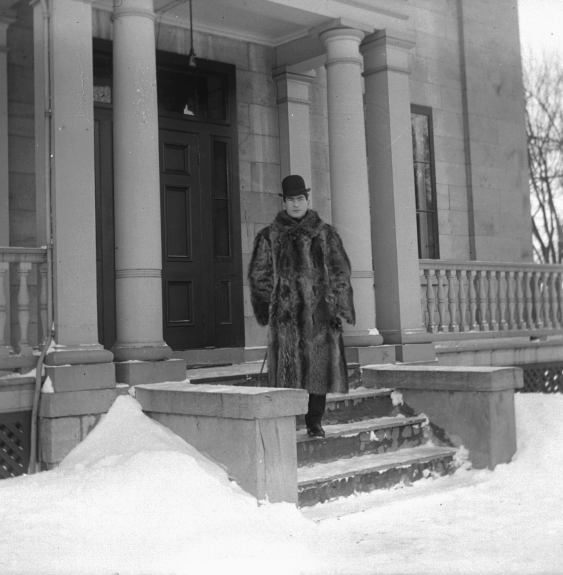
Ils possédaient aussi des tenues communes pour le reste de l’année, portées lors des saisons plus chaudes ou tout simplement à l’intérieur de la maison. La tenue des hommes se composait de plusieurs éléments : tout d’abord les mitasses, un type de jambières qui protégeait les jambes des coupures ou du froid durant l’hiver, et la braguette, une ceinture ajustée à la taille pour maintenir le pantalon et y rentrer la chemise en lin. Le pantalon était lui aussi fait de lin ou de laine, qui sont des matériaux très durables qui leur permettait de conserver leurs vêtements de nombreuses années. Bien sûr, ils sont officiellement restés pionniers jusqu’à que les terres soient complètement défrichées et qu’ils commencent leur travail d’ agriculteur.

Pour les femmes, les vêtements étaient tous très semblables. Elles portaient obligatoirement un casaquin, qui est en fait une veste ajustée venant se placer par-dessus la jupe pour affiner la taille, et qui s’arrête un peu en dessous des hanches. En guise d’accessoire, elles mettaient souvent un tablier par-dessus leur jupe. À cette époque, les femmes travaillaient rarement la terre : elles restaient le plus souvent à la maison pour s’occuper des enfants, cuisiner ou récolter les légumes du potager.

L’ère agricole : des vêtements fonctionnels au fil des saisons

Les Hurtubise ont reçu leur terre pour pouvoir y pratiquer l’agriculture. Cette activité, qui a commencé dans la première partie du 18’ siècle sur les terres dites ‘’Les Hautes-Folies’’, s’est transmise à travers sept générations. Tout au long de cette période, leur style vestimentaire n’a pas vraiment varié : leurs vêtements restaient très semblables. Devenus propriétaires de leur terre, ils travaillaient comme agriculteurs. Les hommes, qui devaient œuvrer dans les champs de produits secs et qui ont dû travailler dans les jardins après 1872 portaient des habits beaucoup moins formels, et il en allait de même pour les femmes, qui s’occupaient de la famille. 
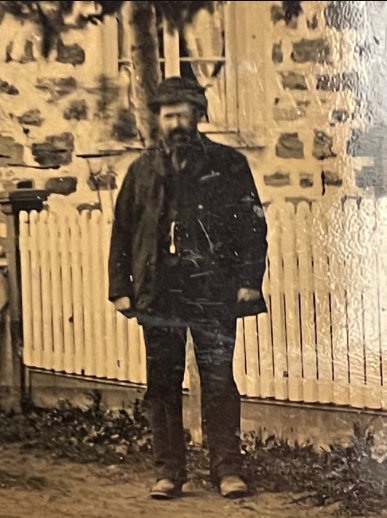
Les hommes de la famille Hurtubise avaient des pantalons et des chemises faits de laine et de coton. Les chemises en lin, quant à elles, sont restées à la mode jusqu’en 1860, époque à laquelle le lin a été progressivement remplacé par le coton. Pendant l’été, les agriculteurs portaient des accessoires indispensables à leur mode de vie. Ils mettaient ce que l’on appelle la « blouse de travail », une blouse bleue ou blanche, qui descendait jusqu’à mi-jambes et que les agriculteurs utilisaient pour protéger leurs vêtement de dessous. 

Les femmes gardaient toujours leurs vêtements de base car, n’étant pas censées travailler dans les champs, elles conservaient leurs longues jupes, leur tablier et leur corset. Toutefois, leurs accessoires ont évolué avec les années, même si le plus durable est resté le fichu : un carré de tissu, semblable à un bandana, que l’on nouait autour du cou pour couvrir le décolleté. Il y avait aussi la coiffe, un bonnet que l’on attachait sous le menton afin de protéger les cheveux de la poussière et du soleil. En hiver, le manteau, quant à lui, restait sensiblement le même.
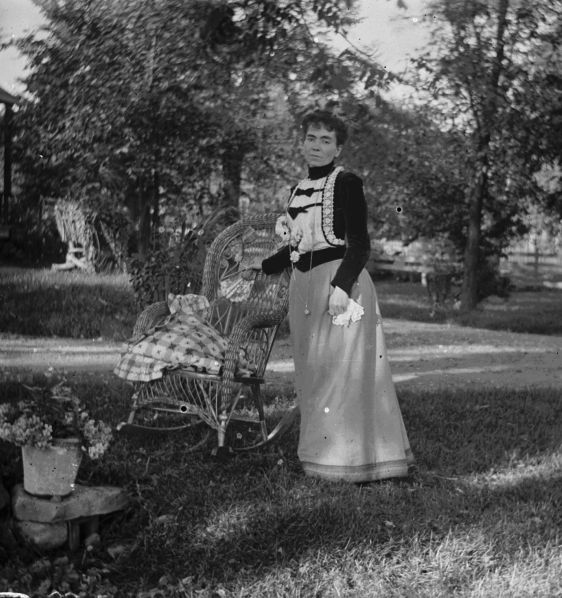
L’essor bourgeois : l’élégance des professions libérales 
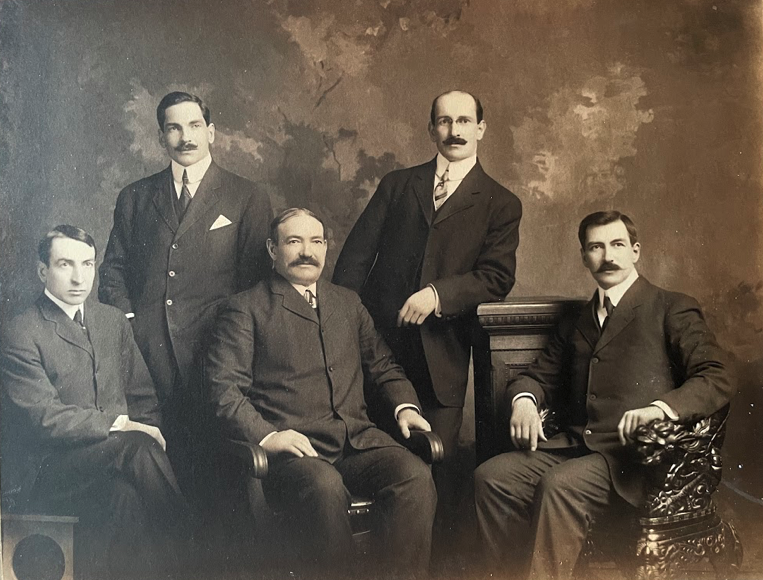
Finalement, le dernier grand tournant pour la famille survient lorsqu’elle délaisse l’agriculture pour s’orienter vers des professions libérales. Les Hurtubise deviennent notamment médecins ou comptables, acquérant ainsi une aisance financière et un statut social plus prestigieux. Les hommes de la famille, exerçant ces nouvelles professions, portent régulièrement le chapeau haut de forme et le costume trois pièces au quotidien. Nos archives conservent d’ailleurs un exemplaire de l’un de ces chapeaux, que vous pouvez venir admirer. Quant aux femmes, elles continuent de porter des jupes et des robes associées à des vestons et l’incontournable corset. Nous avons également la chance de conserver dans nos archives une robe du début du 20è siècle parfaitement préservée. 

En conclusion , l’évolution vestimentaire de la famille Hurtubise témoigne des grands changements sociaux et économiques qu’a connus le Québec au fil des siècles. Des habits rustiques et robustes des premiers pionniers jusqu’aux tenues élégantes de la bourgeoisie urbaine, chaque vêtement raconte leur quotidien. Aujourd’hui, les pièces précieusement conservées dans nos archives nous permettent de remonter le temps et d’admirer de plus près cet héritage unique.

Malaika Duguay Sissoko

Références

A long and full life: who was Suzanne Hurtubise?

08 Aug 24
Etudiant Etudiant
No Comments

What was life life for young girls at the beginning of the twentieth century?  

Suzanne Hurtubise, sometimes referred to as Suzette in our archives, was the daughter of Flavien Hurtubise and Alice Rodier. Flavien being the only Hurtubise brother of his generation to have children, his daughters, Suzanne and Claire, were Dr. Leopold’s only nieces.

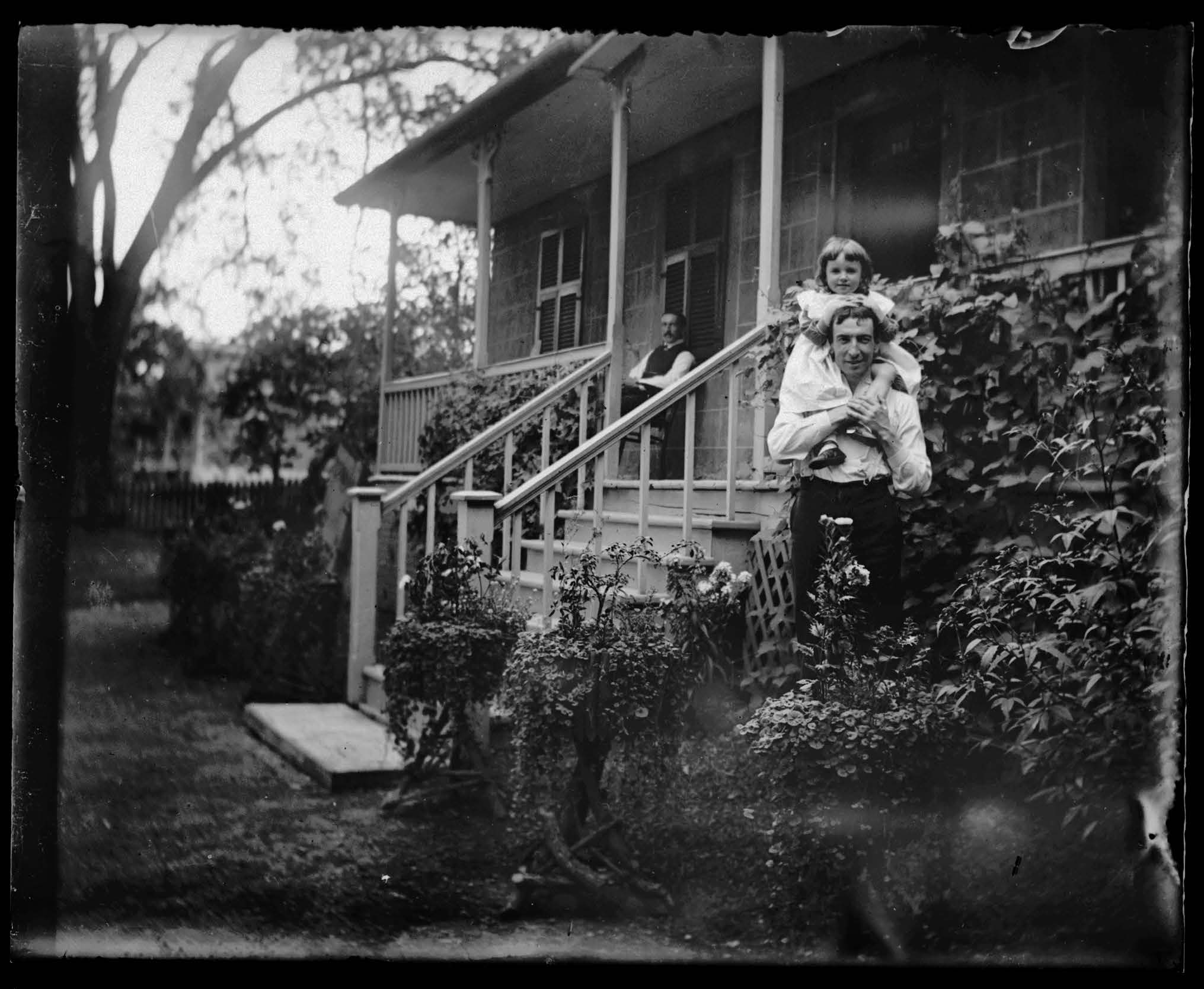
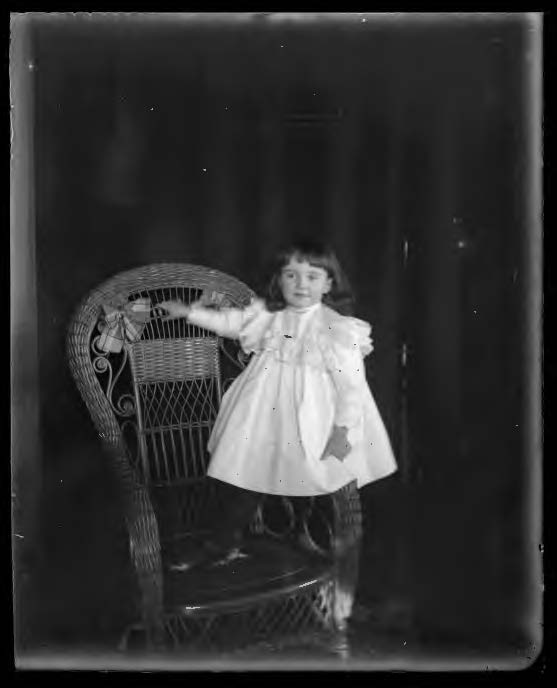
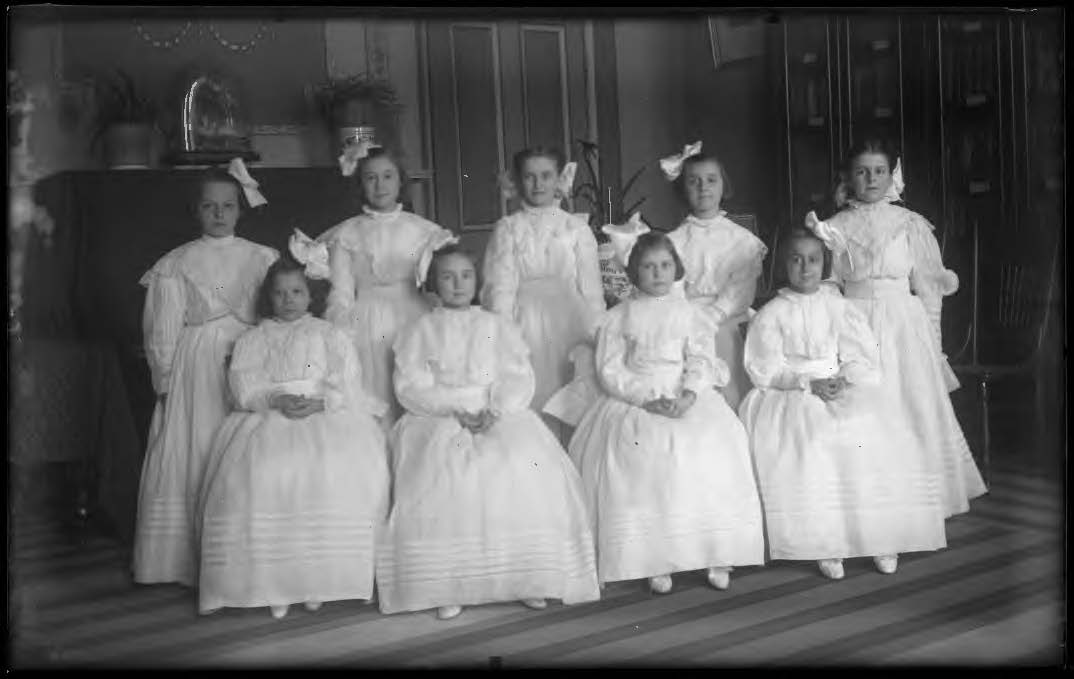
Suzanne appears in several photos taken by Dr. Leopold, now displayed in the Hurtubise House for guided tours. She may have lived in the Hurtubise house with her parents and sister for a time, or she could have often visited the house during summer holidays. For a long time, we only knew that the little girl in the photos was named Suzanne. The hypothesis was that she was Leopold’s niece, but we were unable to confirm the fact. However, a visitor informed us that in one of these photos, Suzanne is in a room which still exists in Villa Maria high school, which allowed us to dive deeper in our research.

Collection de la Maison Hurtubise, “FLV avec Suzette à cheval.” Translation: FLV with Suzette on his shoulders.
Collection de la Maison Hurtubise, “Suzanne au salon.” Translation: Suzanne in the living room.
Collections de la Maison Hurtubise, “Groupe au Couvent 1ere communion de Suzette.” Translation: Group at the convent, Suzette’s first communion.
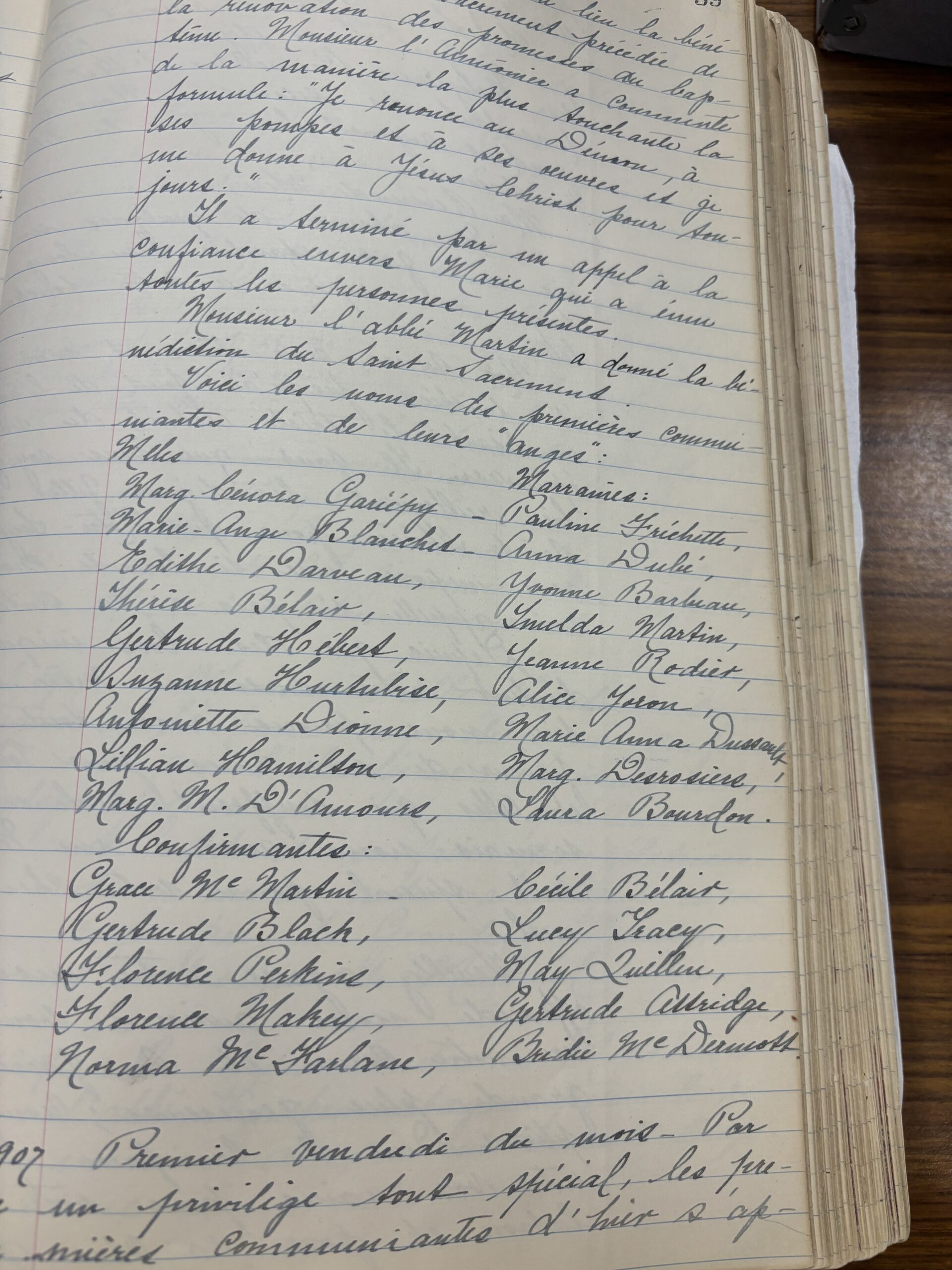
Archives de la Congrégation de Notre-Dame, les Annales de Villa Maria. We can see, under the column for “Mlles” who are participating in the communion, Suzanne Hurtubise’s name.
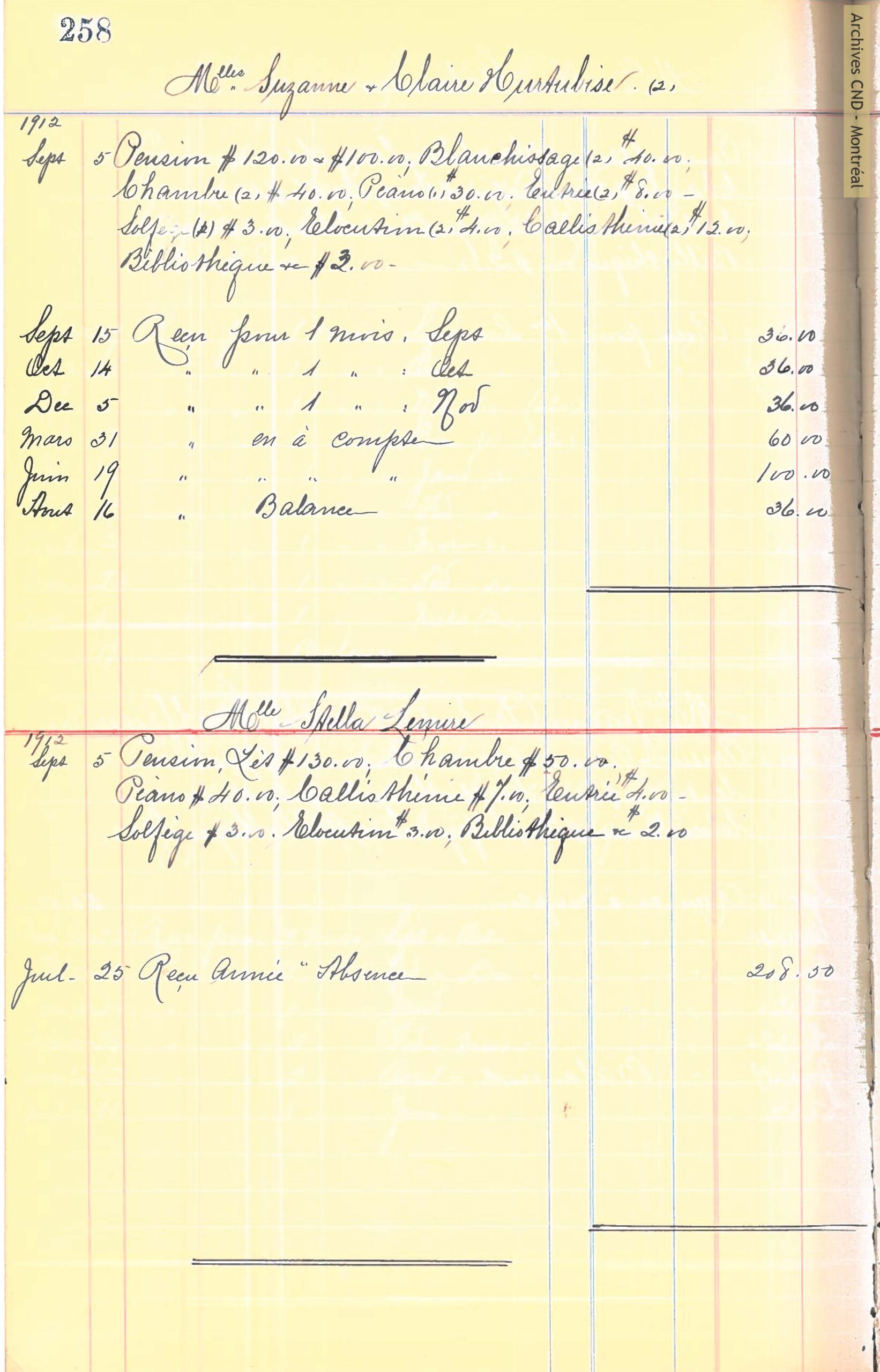
Archives de la Congrégation de Notre-Dame, fichier 326.000.057. At the top, it is written, “Mlles. Suzanne et Claire Hurtubise.” This is a receipt.
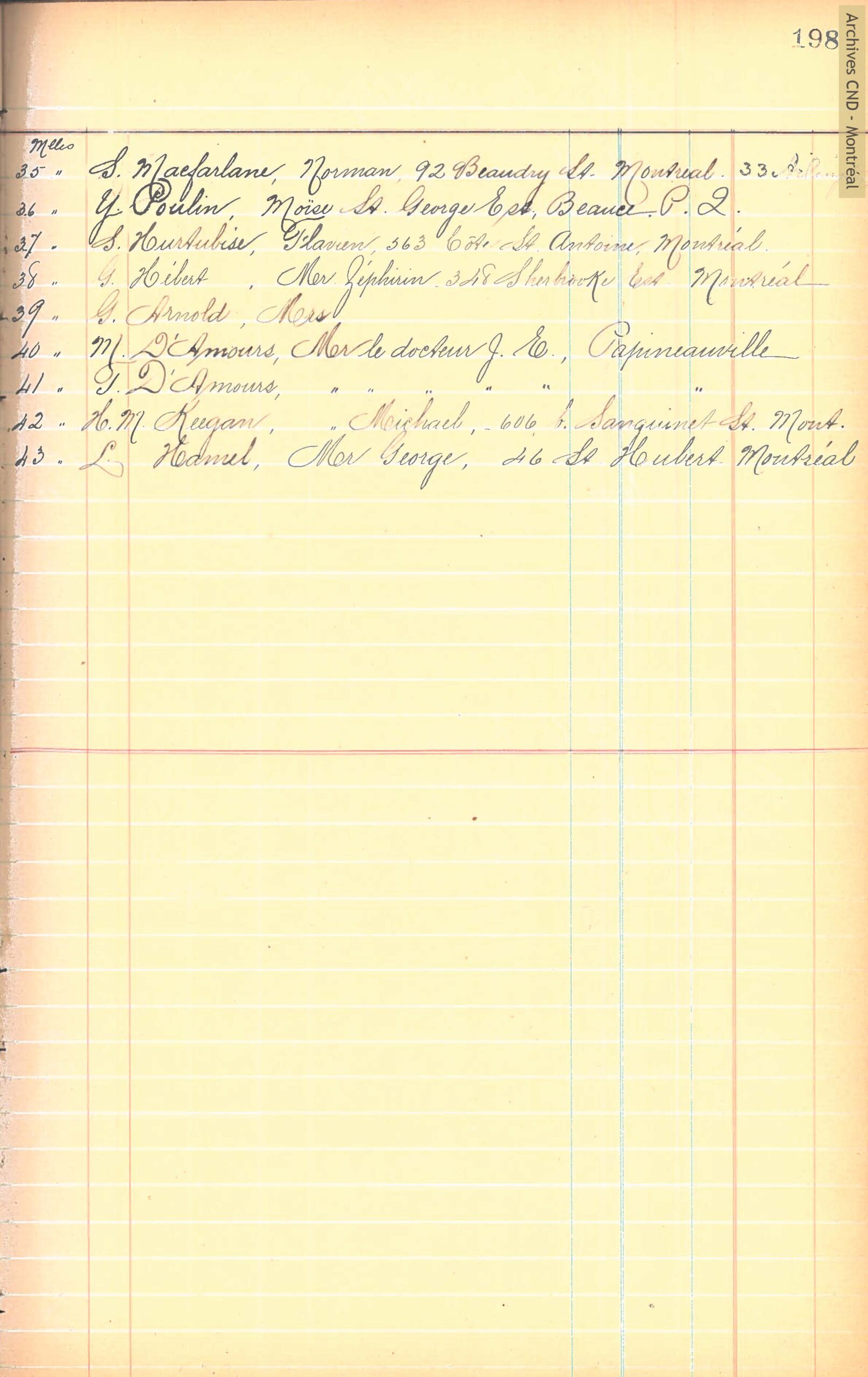
Archives de la Congrégation de Notre-Dame, fichier 326.000.056. We can see written, in the third row, “S. Hurtubise, Flavien, 563 Côte St. Antoine, Montréal.

The fact that Suzanne attended Villa Maria gave us a hint into her education. We found receipts dating from 1906 to 1913. This allows us to understand what kind of education she received. There were boarders and day-to-day students at the primary level, but all high school students were boarders. At the beginning of the twentieth century, Villa Maria had between 170 to 200 students. Amongst this number, many of them came from the United States and stayed at the school except for Christmas and summer holidays. 

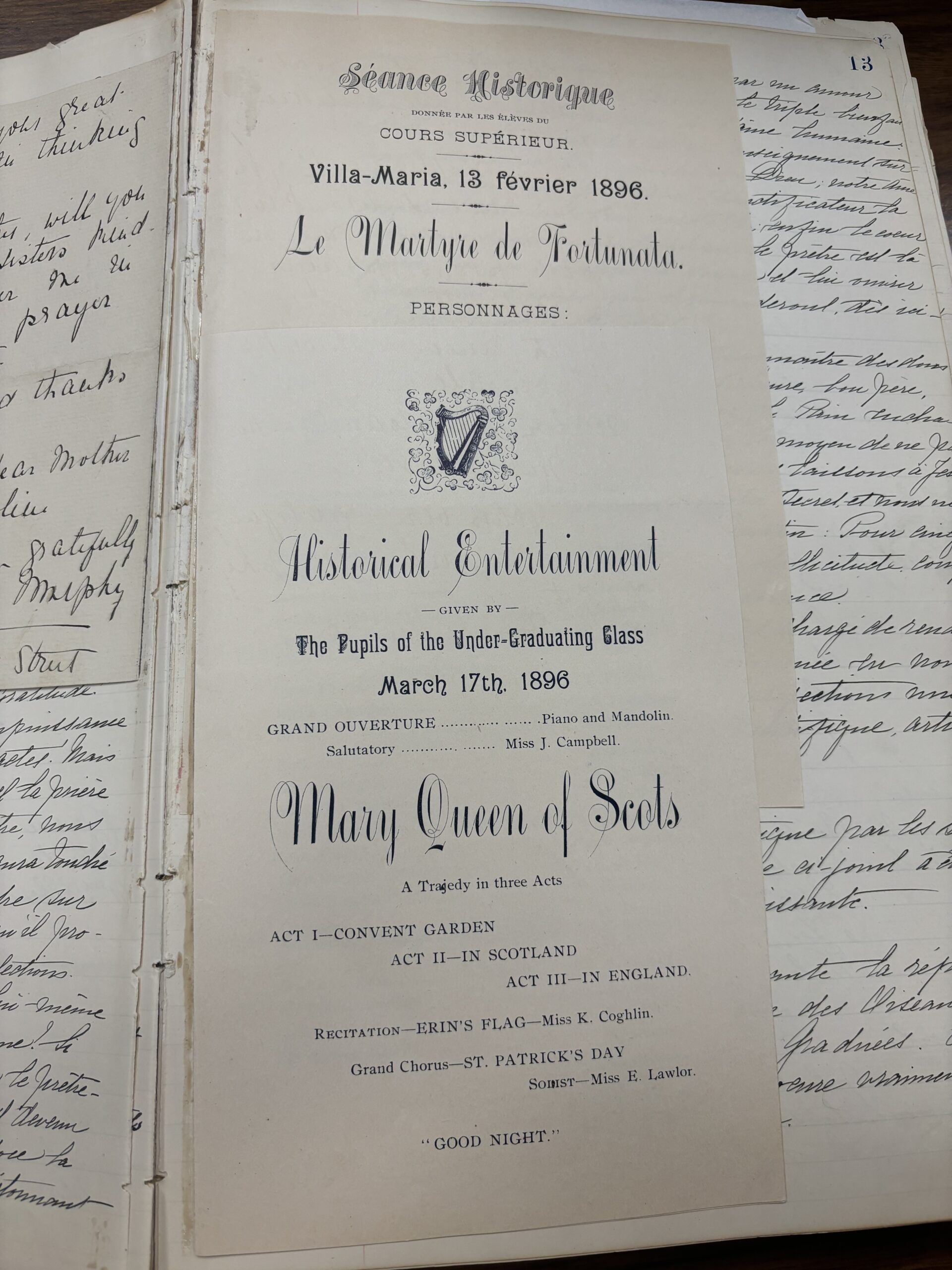
We might guess that a private Catholic school for girls would concentrate solely on religious teachings and “feminine” learning such as sewing and art. Religion indeed played a big role in the school—the students took part in religious feasts, for example—but there was also a myriad of other classes : the girls studied subjects such as astronomy, history, and literature. Professors from Loyola University and Université de Laval were invited to enrich courses for the students. They also sometimes participated in outings —once, the students were invited to Loyola to assist in experiments on X-Rays. There was also time for extracurricular theatre activities. For example, the students performed Shakespeare plays at the schools. After leaving Villa Maria, the young girls probably had one of the most well-rounded educations available in Montreal at the time.1

Archives de la Congrégation de Notre-Dame. A program for “historical entertainment.”
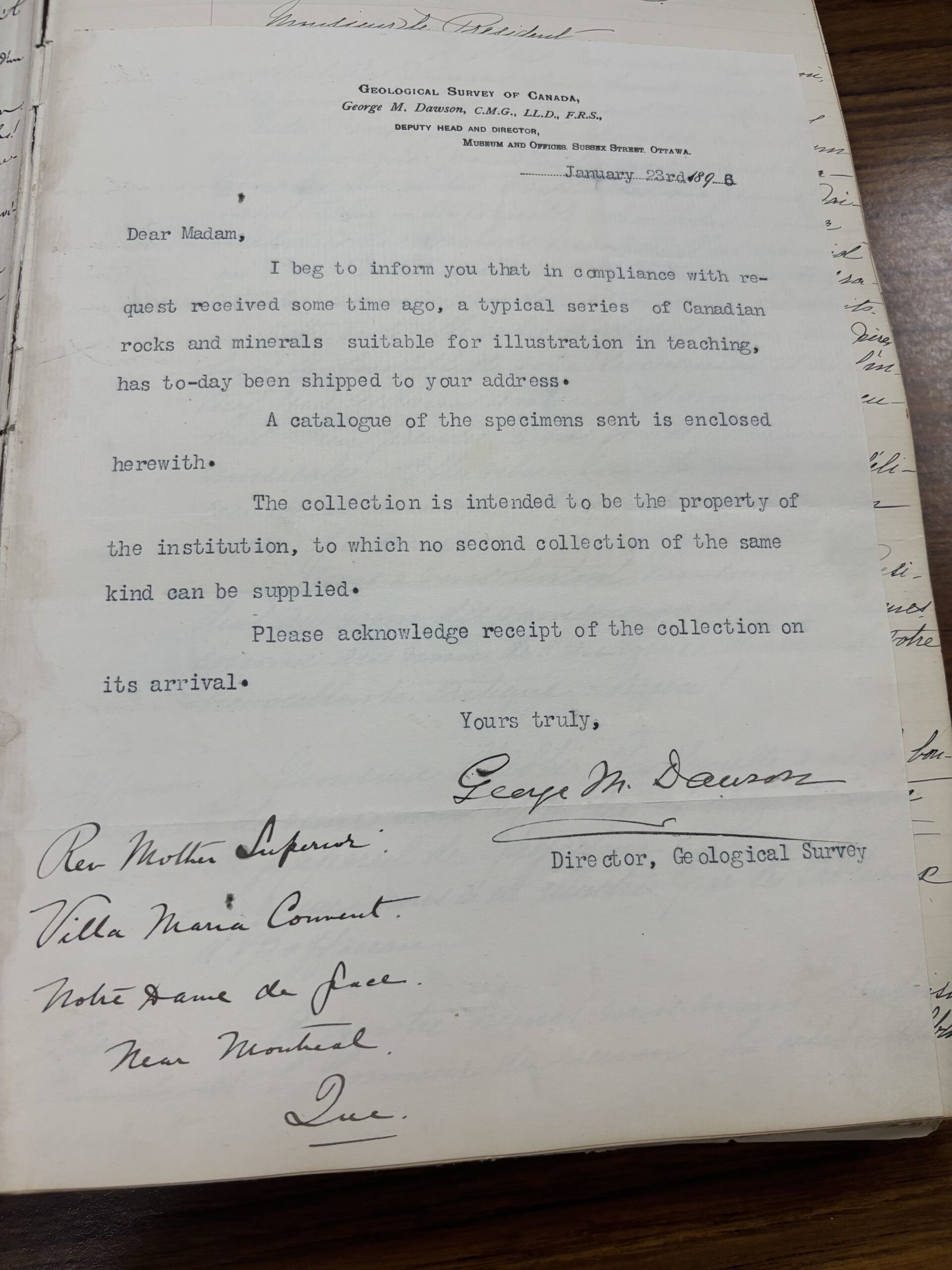
Archives de la Congrégation de Notre-Dame, a letter that shows that Villa Maria school had in its possession a set of rocks and minerals that were used for teaching purposes.

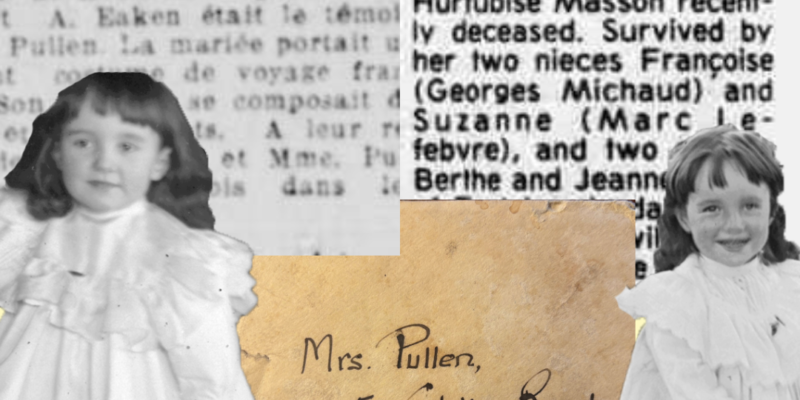
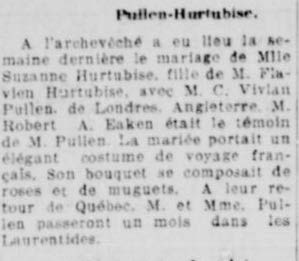
Even after our discovery about Suzanne’s schooling, we had no traces of her after her studies other than letters which are addressed to her in our archives. We did not even know whether the letters we found were for our Suzanne or a different one. However, thanks to deeper research in newspaper archives, we were able to find Suzanne’s wedding notice. In 1920, she marries an Englishman from London, C. Vivian Pullen. Her marriage allows us to understand that the Hurtubise, although French in origin, found themselves in the same social circles as Anglophones in Montreal.  

The marriage notice between C. Vivian Pullen and Suzanne Hurtubise. It is announced in “La Patrie” on June 11, 1920.

Suzanne was also very well-travelled. She would have visited Europe with her husband and later her sister for long periods of time. We also know that she would have visited or lived in New York thanks to letters addressed to a “Mrs. Pullen” at an address in the city.  

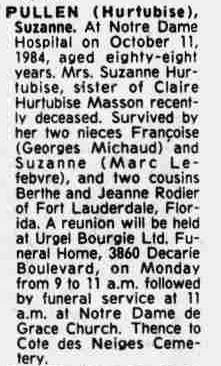
It seems that Suzanne and her husband C. Vivian Pullen never had children. We have not found his first name nor traces of his life in Montreal, but we have found Suzanne’s obituary. She passed away in Montreal in 1984. She was 88 years old, placing her birthdate in 1896. She would have seen the quick urbanization of Westmount with her own eyes, won the federal right to vote with all the women in Canada in 1919 during the first world war, and won the provincial right to vote in Québec in 1940 during the second world war. She lived through Expo 67 and would have seen the 1976 Montreal Olympics. In 1984, she leaves behind two nieces, daughters of Claire, and two cousins from her mother’s side of the family.

Suzanne Hurtubise (Pullen)’s obituary. Found in the Gazette on October 13, 1984.

 Suzanne was buried in the Notre-Dame-des-Neiges cemetery after a long and rich life. It is through the photos of Dr. Leopold displayed in the Hurtubise House that we can now remember her childhood and imagine her life.  

  1. Helen Lanthier, “Monklands Then, Villa Maria Now.” Congrégation of Notre Dame, p. 38–40 
    “Annales de Villa Maria,” Archives de la Congrégation de Notre Dame. 
      ↩︎

An anachronistic porch?

09 Jul 24
Etudiant Etudiant
No Comments

By Julie Jacques

A twentieth century Beaux-Arts style porch on a house dating from 1739 can seem odd at first glance. At the Hurtubise House, this porch is not an anachronism but rather a hint. Its history can help us better understand the family who lived in this historic house for six generations.  

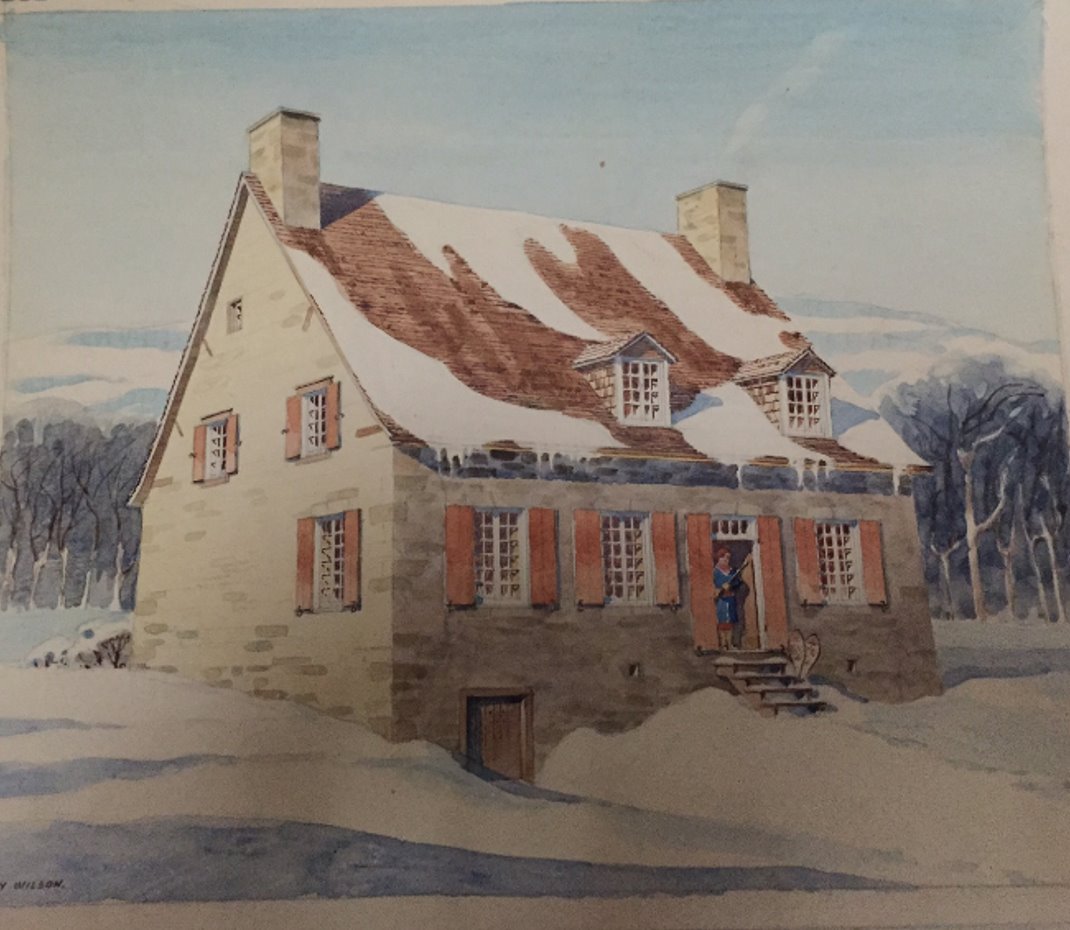
The porch, in any iteration, is not from the original construction of the Hurtubise House. When the structure was built, there were only stairs. The absence of a porch offered easy access to the basement which was probably used for storing harvests during the winter. The door which opens into the basement still exists today under the porch.  

A painting by P. Roy Wilson, an architect and artist, who pictures the house without its porch nor its roof extension. It is also possible to see the door which leads to the basement in the house’s facade.

It is clear that no historical house is without renovations. Each generation of Hurtubise left their own trace on the house and yard which belonged to them. During restorations carried out by the Canadian Heritage of Quebec (CHQ), five distinct layers of flooring were found. As mentioned, the house did not always have a porch, and we do not know exactly when one was added. It would have been added between the first and fourth generation, between 1739 and 1878, in addition to the work to extend the roof, which now covers and protects the porch from the sun and snow.  

However, the old style of the porch can help us reach a more exact estimate. This style, seen in photos from the beginning of the twentieth century, seemed to have a Victorian influence. The porch, and particularly its posts, bears resemblances with other houses around North American of Victorian and gothic rebirth styles.1 Of course, the porch is very simple compared to others of real Victorian style; the Hurtubise House remains a French-Canadian farmhouse. 

Nevertheless, this helps us guess that the porch, or at least this quasi-Victorian iteration of it, was maybe built during the Victorian era between 1838 and 1870. (The Victorian era lasted until 1901, but the brick annex of the house was built in the 1870s. We believe that the porch likely predated the annex.) 

Although we cannot know exactly why the porch was added after the initial construction of the home, it is easy to picture the Hurtubise family enjoying precious summer days, long awaited after a long and harsh winter. They would be protected from the sun by the roof extension while they entertained guests or finished household chores—I think of my grandmother who recalls that her grandmother often sewed while sitting outside during the summer.  

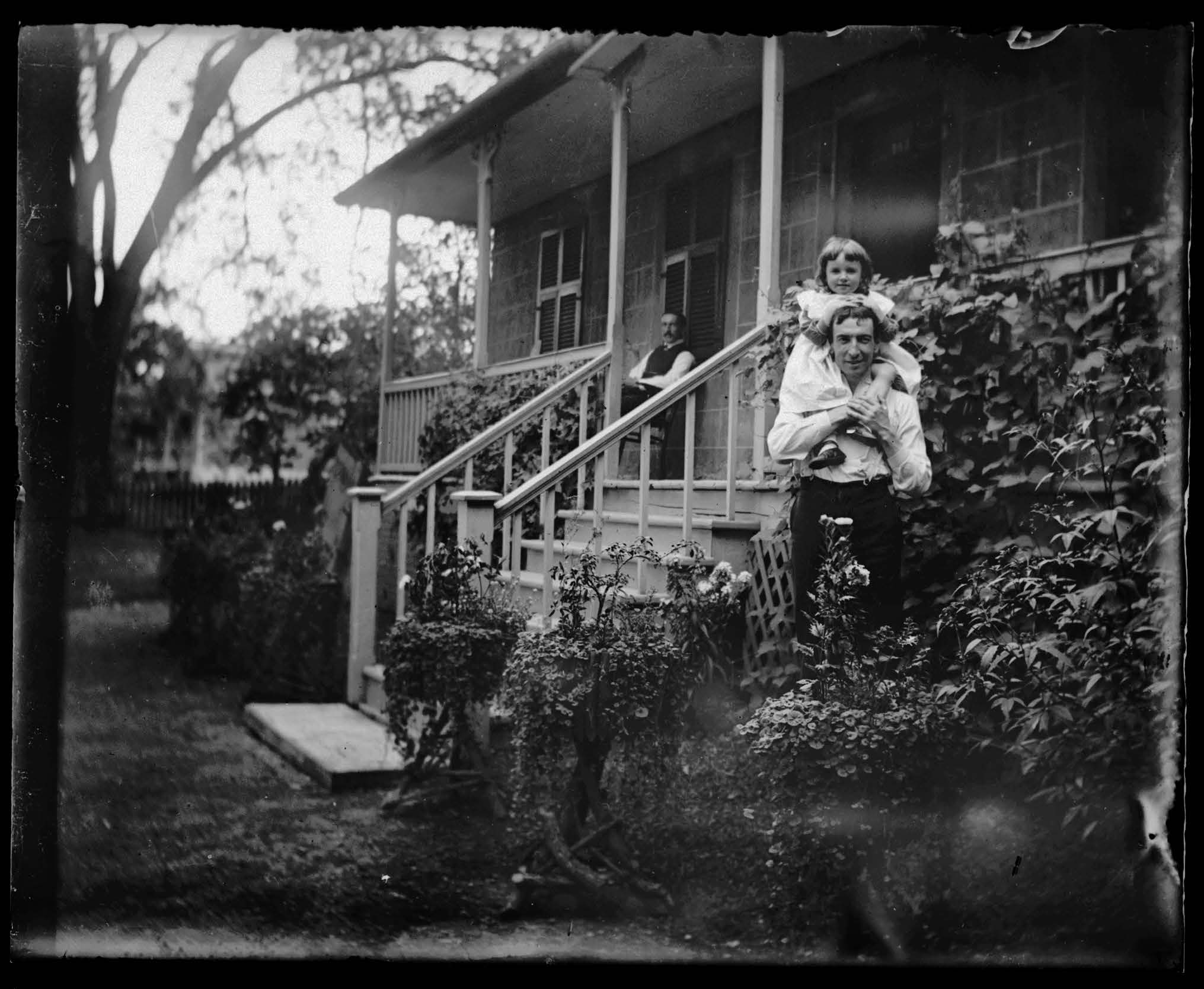
A photo taken by Dr. Hurtubise where we see his brother, Flavien, and another member of the family, Suzanne, in front of the porch before the 1911 renovations.
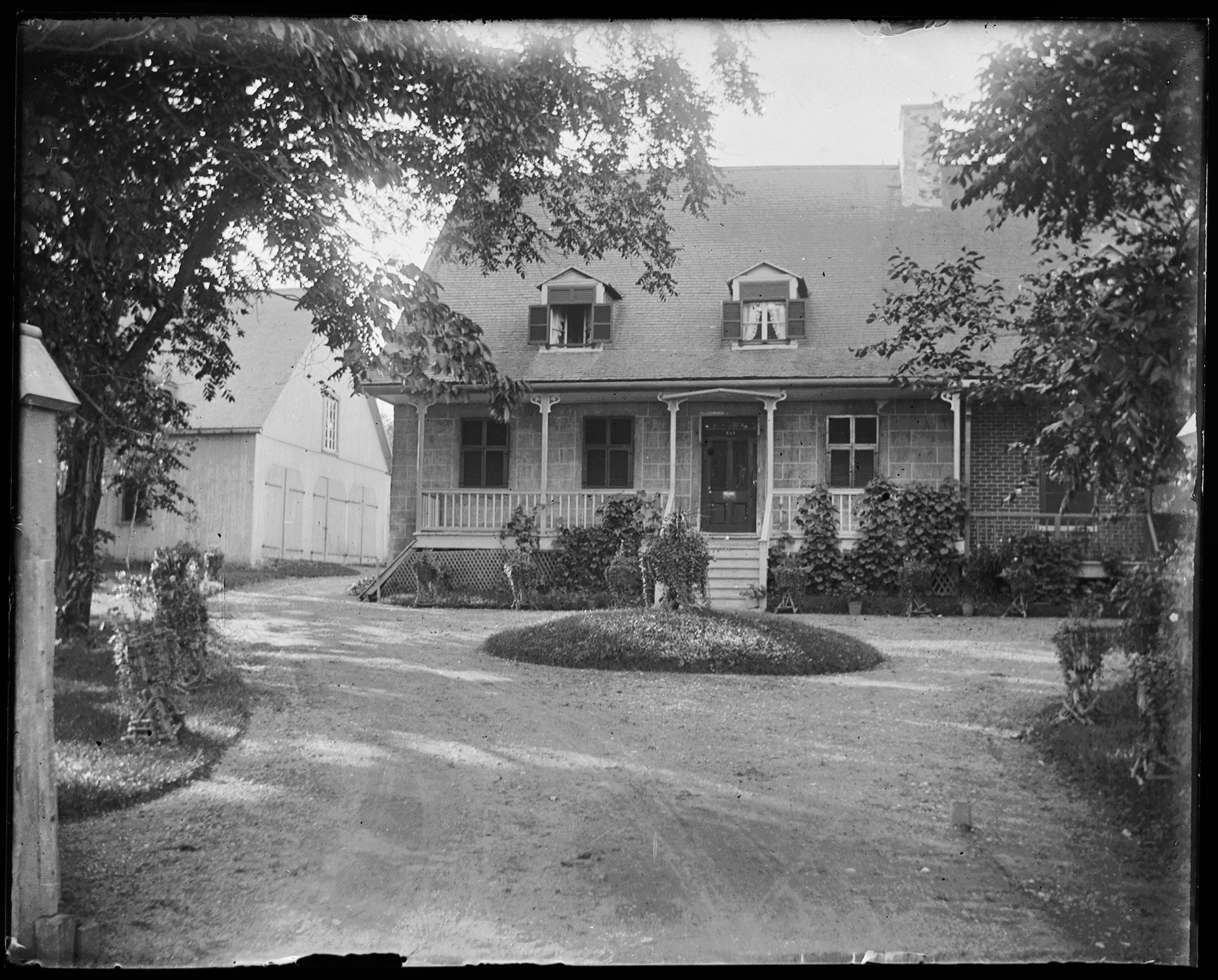
A photo, taken by Dr. Léopold Hurtubise, of the Hurtubise House before the renovations of 1911 which changed the style of the porch.
Photo and description from the book “Porches of North America,” cited below, which shows a house with a similar style of post to the old porch of the Hurtubise House.2

Dr. Leopold Hurtubise, the last Hurtubise to have lived in this home, was responsible for the Beaux-Arts style porch, dating from 1911. From this, as well as from the photos he took with his bicycle camera over the course of his studies, we can guess that he was a man who appreciated the arts. As a doctor and amateur photographer, we see in his personality a marriage of arts and sciences. His photos show his appreciation for this porch and the exterior and nature which surrounded the Hurtubise House.  

Don’t hesitate to come and see the evolution of the porch as part of our temporary exhibition on the photos of Dr. Hurtubise, included in the visit to the Hurtubise House https://hcq-chq.org/the-hurtubise-house!

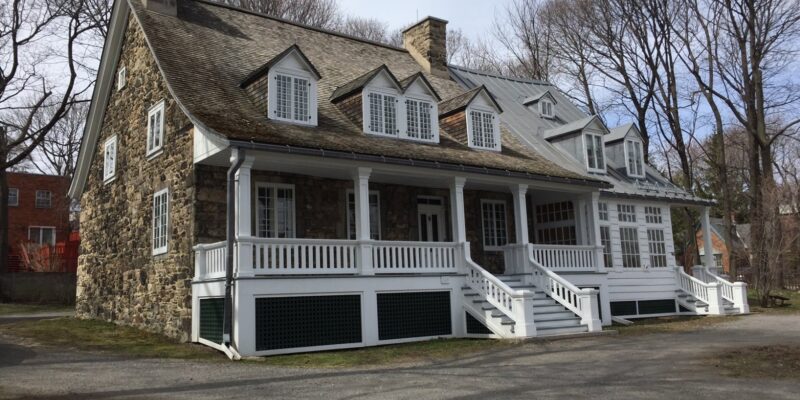
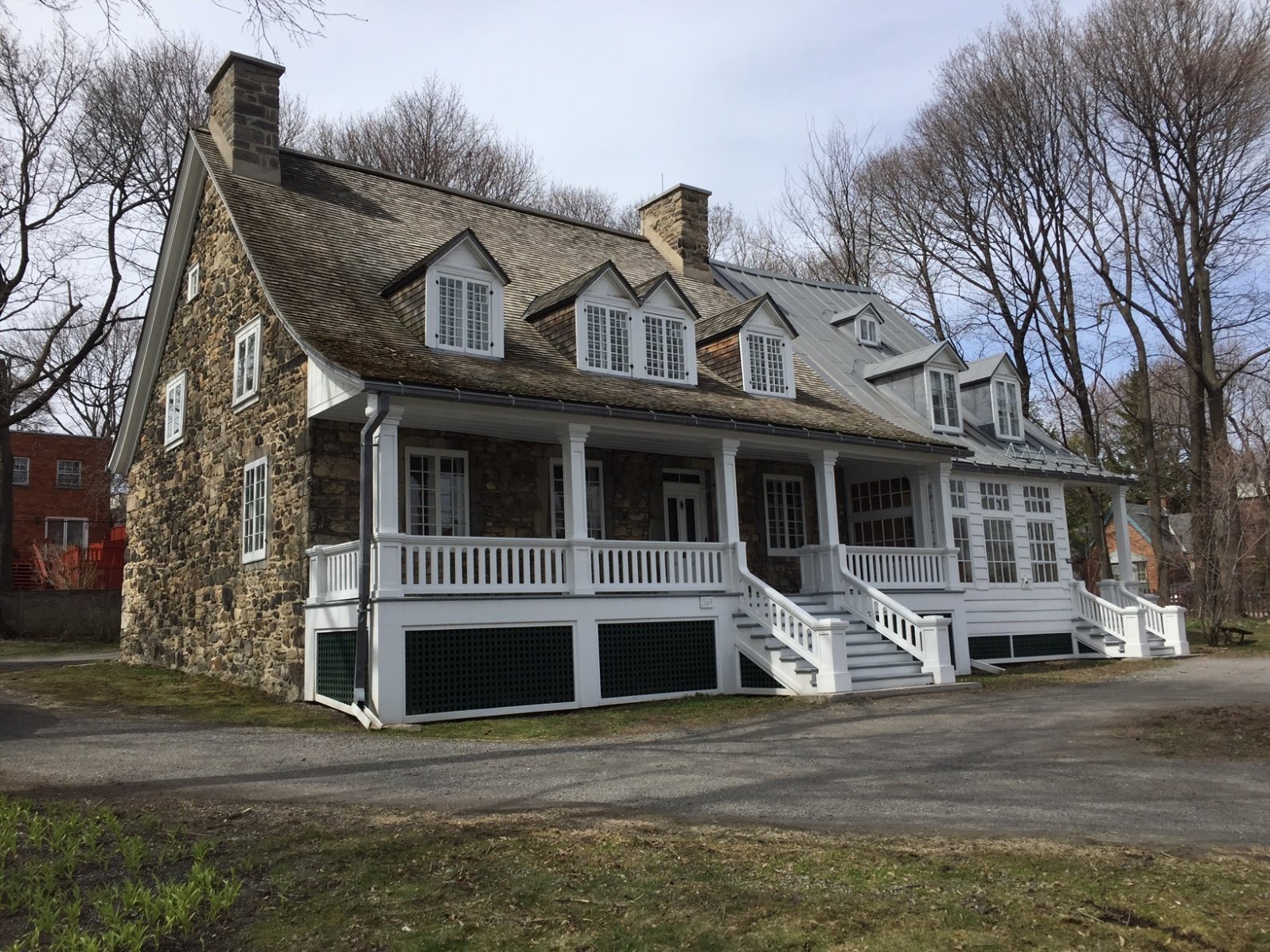
The Beaux-Arts style porch after the restorations done by the Canadian Heritage of Quebec in 2005 and 2012.
  1. Thomas Durant Visser. “Victorian Porch Styles,” Porches of North America. University Press of New England, 2012.  ↩︎
  2. Thomas Durant Visser. “Victorian Porch Styles,” Porches of North America. University Press of New England, 2012.  ↩︎

The Myth of the Montreal Melon

19 Jun 24
Etudiant Etudiant
No Comments
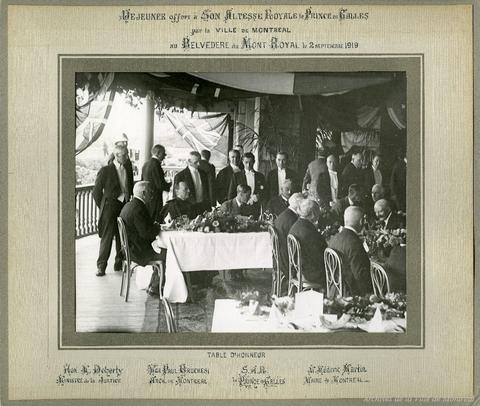
Source: Archives de la Ville de Montréal. The photo shows a breakfast that took place in 1919, at the Belvedere du Mont Royal, with His Royal Highness the Prince of Wales. We can see that guests were served sliced melon . . . maybe even the famous Montreal melon?
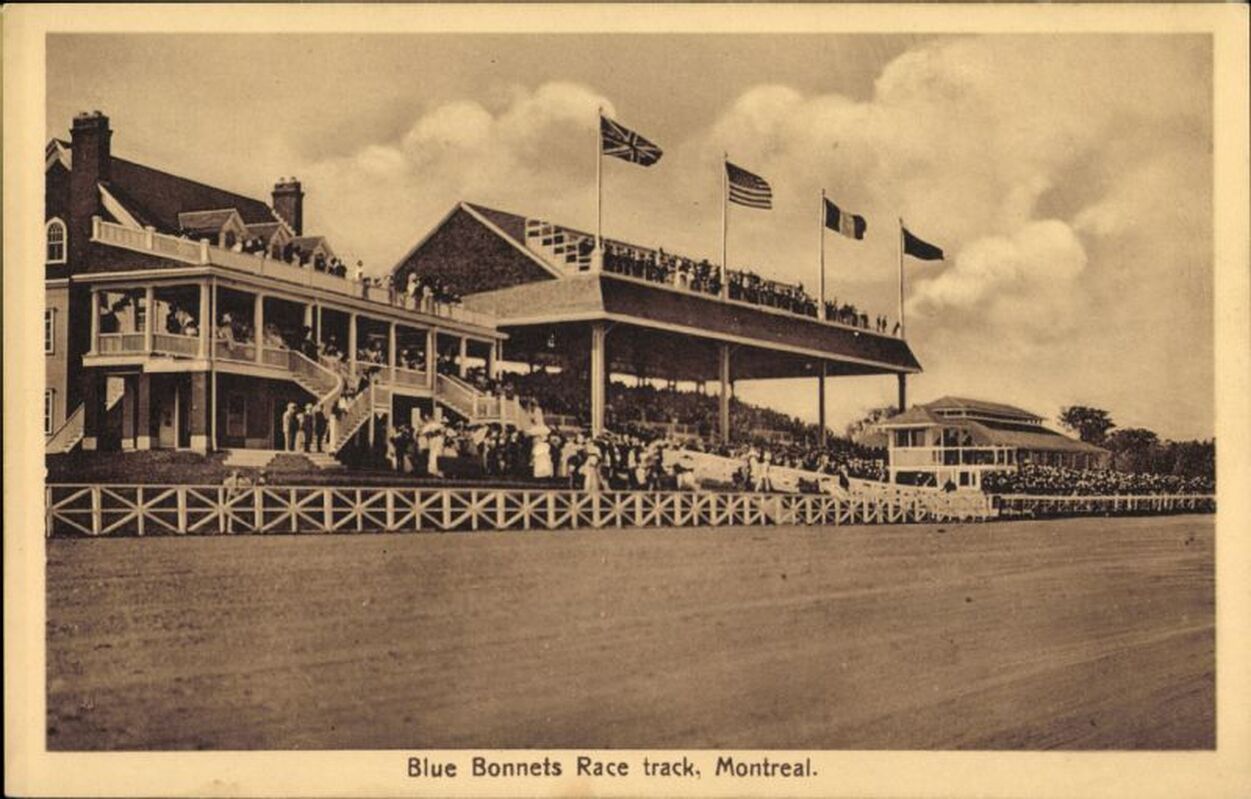
Source: https://www.montrealbicycleclub.com/blue-bonnets.html
The “Blue Bonnet” hippodrome, which would have been built next to today’s Montreal-West train station, and, after being cut in half by a new rail line in 1886, be moved to the Décarie boulevard in 1907.
  1. Daphné Cameron, “Le mystère du melon de Montréal enfin résolu?” La Presse, 8 June 2024.
    Tori Marlan, “This Melon Used to Sell for $24 a Slice. Should it Make a Comeback?” Buzzfeed News, 3 January 2016. ↩︎
  2. Daphné Cameron, “Le mystère du melon de Montréal enfin résolu?” La Presse, 8 June 2024.
    Fabien Deglise, “Le melon de montréal ne fait plus le poids,” Le Devoir, 11 October 2006.
    Sophie Lachapelle, “Un melon mythique!” L’actualité.com, 22 April 2013.
    Clémence Ménard, “Vers un possible retour du melon de Montréal?” Ville en vert, 1 September 2021. ↩︎
  3. Tori Marlan, “This Melon Used to Sell for $24 a Slice. Should it Make a Comeback?” Buzzfeed News, 3 January 2016. ↩︎
  4. Tori Marlan, “This Melon Used to Sell for $24 a Slice. Should it Make a Comeback?” Buzzfeed News, 3 January 2016.
    L’histoire du melon de montréal, Quelle histoire!, accédé le 17 juin 2024. ↩︎
  5. Alan M. Stewart et Léon Robichaud. “Étude patrimoniale de la maison des Hurtubise : Rapport présenté au Ministère de la Culture et des Communications et à l’Institut d’histoire de l’Amérique française,” mai 2001.  ↩︎
  6. Daphné Cameron, “Le mystère du melon de Montréal enfin résolu?” La Presse, 8 juin 2024. 
    Clémence Ménard, “Vers un possible retour du melon de Montréal?”  Ville en vert, 1 septembre 2021. ↩︎ ↩︎
  7. Daphné Cameron, “Le mystère du melon de Montréal enfin résolu?”  La Presse, 8 juin 2024.  ↩︎
  8. Daphné Cameron, “Le mystère du melon de Montréal enfin résolu?” La Presse, 8 juin 2024. 
    Clémence Ménard, “Vers un possible retour du melon de Montréal?”  Ville en vert, 1 septembre 2021.  ↩︎
  9. « Le projet ‘agriculturel’ de la maison Hurtubise. »  hcq-chq.org
    https://hcq-chq.org/le-projet-agriculturel-de-la-maison-hurtubise/ ↩︎ ↩︎